Not All Land Surveys Are the Same. Here’s How to Know Which One You Need
Most people assume a land survey is a land survey. You call someone, they walk your property, and you get a map. Simple enough. But ask for the wrong type and you could end up paying for something your lender, your contractor, or your title company won’t accept.
There are several types of land surveys, and each one is built for a specific purpose. Knowing the difference before you hire saves you time, money, and a lot of back-and-forth.
What Is a Land Survey, Exactly?
A land survey is a professional measurement of a property’s boundaries, features, and physical conditions. A licensed land surveyor uses field equipment, legal records, and established methods to produce a document that’s legally recognized. Most real estate transactions, construction projects, and permit applications require one before any work begins.
The type of survey you need depends entirely on what you’re trying to do with the property.
What Are the Different Types of Land Surveys?
The most common types are boundary surveys, ALTA surveys, topographic surveys, as-built surveys, elevation certificates, and plat surveys. Each one measures something different and serves a different situation.
Boundary Survey
A boundary survey locates and confirms the legal corners and lines of a property. It’s the go-to survey for most homeowners.
What it’s used for:
- Resolving a dispute with a neighbor
- Installing a fence on the correct line
- Buying or selling residential property
Typical cost: $500 to $1,500 for a standard residential lot, depending on size and location.
ALTA Survey
An ALTA survey follows strict national standards set jointly by the American Land Title Association (ALTA) and the National Society of Professional Surveyors (NSPS). These standards are updated every five years to reflect changes in property law and industry practice.
What it’s used for:
- Commercial real estate transactions
- Lenders and title companies requiring a higher level of detail
- Properties with complex easements, encroachments, or improvements
An ALTA survey goes well beyond a basic boundary survey. It documents utilities, improvements, encroachments, access points, and much more. If a lender or title company has asked for one by name, you need this specific type, not a general property survey.
Topographic Survey
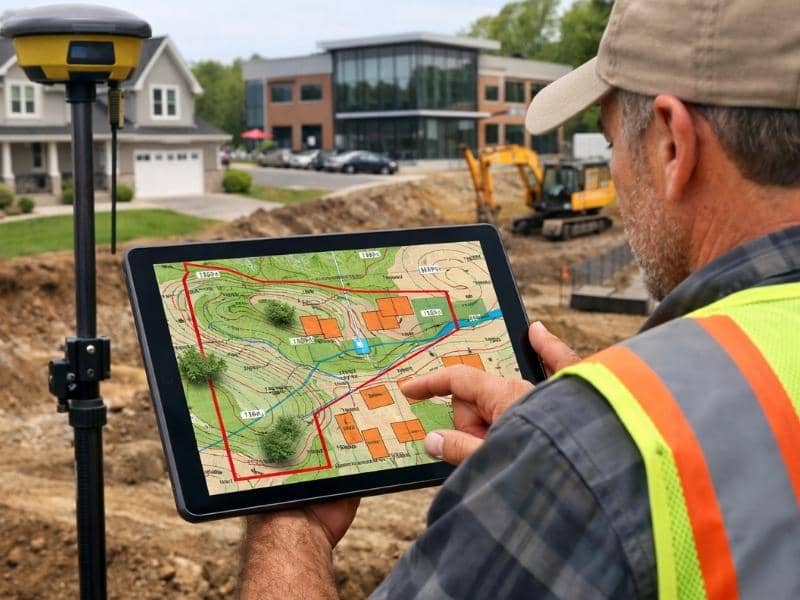
A topographic survey maps the elevation and physical features of land. It shows slopes, drainage patterns, trees, structures, and contour lines.
What it’s used for:
- Planning a construction or grading project
- Designing drainage or stormwater systems
- Landscaping or site development
Engineers and architects use topographic data to design structures that fit the natural lay of the land. Without it, a project can run into serious drainage or grading problems after construction starts.
As-Built Survey
An as-built survey documents what was actually constructed on a property after work is complete. It compares the finished structure to the original approved plans.
What it’s used for:
- Confirming that a building was constructed as permitted
- Closing out a construction loan
- Satisfying a local permit or inspection requirement
Lenders and local governments often require an as-built survey before they release final funds or issue a certificate of occupancy.
Elevation Certificate
An elevation certificate is a form completed by a licensed surveyor that documents the elevation of a structure relative to the base flood elevation in that area.
What it’s used for:
- Applying for or renewing flood insurance through the National Flood Insurance Program (NFIP)
- Appealing a FEMA flood zone designation
- Determining accurate flood insurance premiums
A lower elevation relative to the flood zone can mean higher premiums. In some cases, an elevation certificate can demonstrate that a property is actually at lower risk than FEMA’s map suggests, which can reduce insurance costs significantly.
Plat Survey
A plat survey creates a formal map of a parcel or subdivision that gets recorded with the county. It shows lot lines, dimensions, easements, rights-of-way, and other legal details.
What it’s used for:
- Subdividing land into multiple parcels
- Creating a new subdivision for development
- Recording a formal legal description of a newly divided tract
If you’re splitting a single parcel into two or more lots, a plat survey is typically required by the local government before any lot can be legally sold or built on.
How Do You Know Which One You Need?
Here’s a simple way to think about it:
- Buying or selling a home? A boundary survey confirms what you’re actually purchasing.
- Lender or title company involved in a commercial deal? Ask specifically if they require an ALTA survey.
- Planning to build, grade, or install drainage? Order a topographic survey first.
- Project just finished? An as-built survey documents what was built.
- In or near a flood zone? An elevation certificate may lower your insurance rate.
- Splitting land into new lots? A plat survey is what gets recorded with the county.
When you’re not sure, describe your project to a licensed land surveyor and ask which type applies. That conversation is usually free, and it saves you from ordering the wrong thing.
A Note on Who Can Perform a Survey
In all 50 U.S. states, land surveys that produce a legally binding document must be completed by a licensed Professional Land Surveyor (PLS). Licensing requirements vary by state but generally include a combination of education, field experience, and a written exam. When comparing quotes, always confirm that the person signing and sealing the work holds an active PLS license in your state.