
Before You Grade or Build Anything, Get a Topographic Survey First
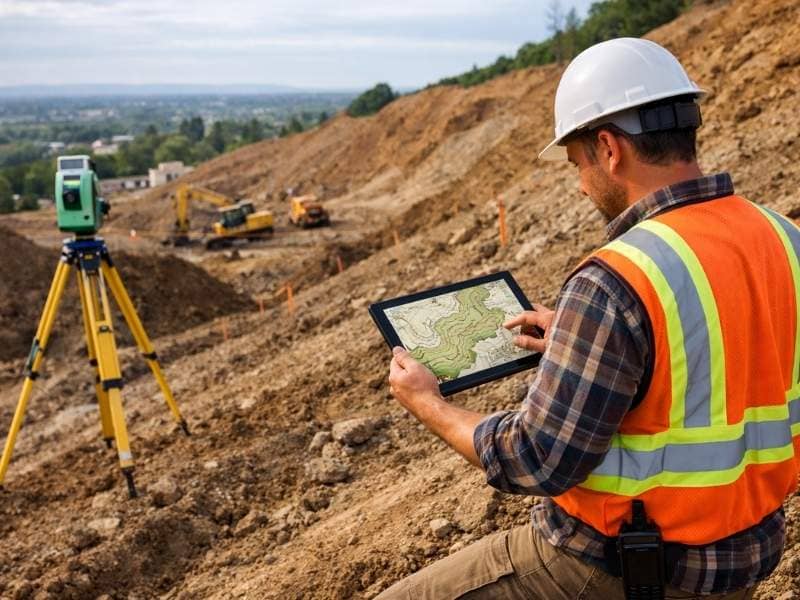
Most construction problems start before anyone picks up a shovel. The slope was wrong. Water runs toward the building instead of away from it. The driveway needs twice as much fill as the contractor planned for. These aren’t random surprises. They’re things a good survey would have caught before the project started.
A topographic survey tells you what the land is actually doing before you spend money on a design or a permit.
What a Topographic Survey Tells You
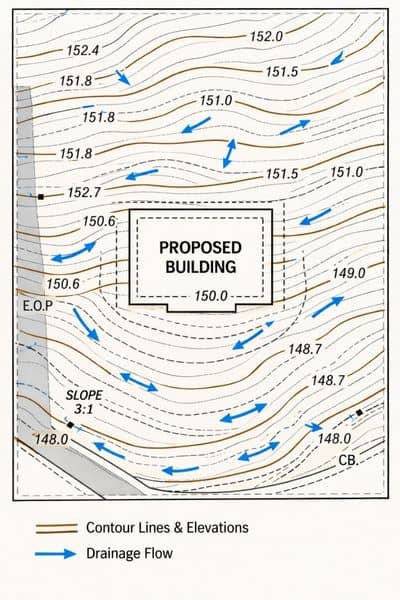
A topographic survey measures the height of the land across a site. It shows high spots, low spots, slopes, and how water would naturally drain. It also maps physical features like trees, ditches, fences, existing buildings, and utility lines.
The end result is a drawing that lets an engineer or architect understand the land in three dimensions before any work begins.
This is not the same as a boundary survey, which shows where your property lines are. And it is not the same as an as-built survey, which records what was built after construction. A topographic survey is purely about what the ground looks like right now, and what that means for your project.
What Goes Wrong Without One
Skipping a topographic survey is one of the most common reasons construction budgets blow up. Here is what tends to happen.
Water ends up in the wrong place. A parking lot, building pad, or driveway that sends water toward a structure instead of away from it usually means the grading plan was based on guesswork. Fixing drainage after a concrete slab has been poured means cutting into finished work. That gets very expensive, very fast.
Dirt estimates are way off. Grading a site means moving dirt. How much dirt needs to move depends on the actual elevation of the land. Without accurate survey data, contractors guess. When the terrain turns out to be more complicated than expected, the estimates change and change orders follow.
Retaining walls appear out of nowhere. A slope that looks fine in person can require a full engineered retaining wall once a grading plan is actually drawn. If no one catches this until the design is done and permits have been applied for, the whole design may need to start over.
Stormwater plans get rejected. Most cities and counties require a stormwater plan as part of a building permit. That plan has to show how the site will handle rain runoff. Without solid elevation data, the plan won’t hold up. A rejected plan means delays, revisions, and lost time.
The foundation carries more risk. Engineers need elevation data to design a foundation that fits the site. A foundation built without it is based on assumptions. That is a risk no one wants.
Who Should Order One
Topographic surveys are not just for big commercial projects. If your project involves changing the ground level, adding a structure, or managing water runoff, you should have one.
Homeowners adding an addition or outbuilding. If the new structure sits on sloped ground or near a low spot, elevation data helps the designer get the placement right from the start.
Anyone installing a pool. Digging a pool on a sloped lot can uncover soil and drainage conditions you didn’t expect. Knowing the grade before the design is locked in avoids expensive changes after the hole is already dug.
Developers planning a subdivision or apartment project. Road layout, lot grading, utility placement, and stormwater design all depend on knowing how the land sits. Getting this data early reduces surprises at every step that follows.
Anyone building near water. If your project is near a creek, pond, or low-lying area, drainage gets complicated fast. A topographic survey shows exactly how water moves across the site during a rain event.
Contractors bidding on grading jobs. Accurate elevation data means accurate earthwork estimates. Bidding on grading without it means guessing, and a bad guess in either direction costs someone money.
When Should You Order It
Order the topographic survey before design work starts. By the time an architect or civil engineer begins drawing a site plan, they need to know what the terrain looks like. Finding out the grade doesn’t work after a design is half finished means redoing work that’s already been paid for.
For most projects, the order looks like this: topographic survey first, boundary survey at the same time or shortly after, then design, then permitting.
Not every project needs both. A simple fence only needs a boundary survey. A new home on a flat suburban lot with clean records may not need detailed topographic work. But if the project involves any change in grade, or if the permit requires a stormwater plan, the topographic survey comes first.
How Much Detail Do You Need
Not all topographic surveys capture the same level of detail. A small residential lot may only need elevation readings at a handful of key points. A large development site needs a dense grid of measurements that can produce contour lines at one-foot or two-foot intervals.
The right level of detail depends on what the data will be used for. Before ordering, ask the engineer or architect who will be working with the survey what they need. They will typically spell out the contour interval, the accuracy required, and which features need to be included. Getting those specs to the surveyor before the job starts means you get data that works for permits and design, instead of data that has to be redone.
Frequently Asked Questions
Does a topographic survey include property lines?
Not by default. A topographic survey focuses on elevation and physical features. Property lines can be added if a boundary survey is done at the same time, but they are two separate products. If you need both in one drawing, ask the surveyor upfront. Many firms offer them as a combined service, and a single sheet with all the information is easier for designers to work from.
Can you use free government elevation data instead?
Public datasets from government agencies are fine for early planning and rough screening. But they are often lower resolution and may be several years old. For permit applications, engineering work, and construction, most local governments require survey-grade data signed and sealed by a licensed professional. Free data is a starting point, not a replacement.
How long does a topographic survey take?
A typical residential lot takes three to five business days. Larger or more complex sites take longer. If you are combining a topographic and boundary survey, the timeline covers both. Sharing any existing records, plat maps, or prior surveys with the surveyor at the start helps move things along.
What is the difference between a topographic survey and a grading plan?
A topographic survey records what the ground looks like today. A grading plan is a design that shows how the ground will be changed during construction. The grading plan is created by a civil engineer using the topographic survey as a starting point. The surveyor produces one, the engineer produces the other, and neither does their job well without the other.
Do I need a topographic survey to pull a building permit?
It depends on your city or county and the size of the project. Many permit offices require a survey or site plan that shows existing grades for new construction, additions, or any project with grading work. Check with your local permit office early so you know what’s required before you lock in your timeline.