What Is an ALTA Survey and Why Does Your Lender Keep Asking for One?
You’re a few weeks into a commercial real estate transaction and your lender sends over a checklist. Near the top is a requirement you may not have seen before: an ALTA survey. If you’ve bought residential property before, this probably isn’t something you’ve dealt with.
What an ALTA Survey Actually Is
An ALTA survey is a property survey that follows a joint national standard set by the American Land Title Association and the National Society of Professional Surveyors. The abbreviation ALTA/NSPS refers to both organizations, though most people shorten it to ALTA.
The standard exists for one core reason: lenders, title insurers, and investors need a consistent, reliable picture of a commercial property regardless of where it’s located. A boundary survey prepared in one state may look very different from one prepared in another. An ALTA survey looks the same everywhere because it has to meet the same requirements nationwide.
Why Lenders Require It
When a lender finances a commercial property, they are taking on significant risk. If the borrower defaults, the lender may end up owning the property. They need to know exactly what they’re getting.
An ALTA survey gives a lender confidence on several specific questions that a standard boundary survey simply does not answer.
Does the property have legal access to a public road? A commercial building with no legally established access to a street has a serious problem. The ALTA survey confirms how access is established and whether it depends on easements that could be challenged or lost.
Are there encroachments that could create legal liability? If a neighboring building, fence, or parking lot crosses onto the property being financed, that’s a title issue. The lender needs to know before the loan closes, not after.
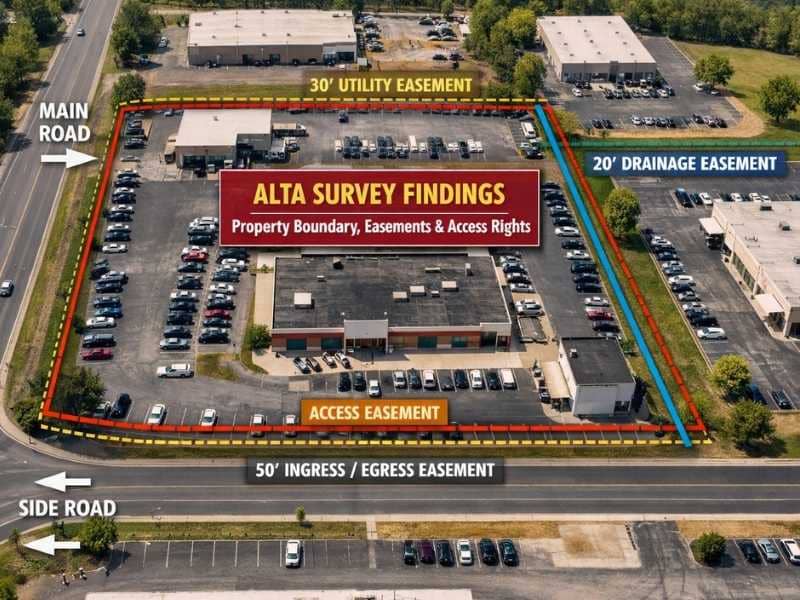
Do recorded easements affect how the property can be used? A utility corridor running through the middle of a parcel can limit where a buyer can build or expand. An overhead power line easement may restrict building height. These restrictions directly affect the property’s value as collateral.
Does anything on the ground conflict with what the public records say? Sometimes a property looks fine on paper but has real-world conditions that the deed and title search don’t capture. The ALTA survey is a physical check on that.
Why the Title Company Needs It Too
A title insurer’s job is to guarantee that the buyer’s ownership of the property is free from undisclosed claims or defects. To do that, the title company needs to know what physical conditions exist on the property that might affect that guarantee.
Without a current ALTA survey, title policies typically include a broad “survey exception,” which is a clause that excludes from coverage anything a survey would have revealed. This exception protects the title insurer but leaves the buyer and lender exposed to physical and legal problems the policy won’t cover.
When a satisfactory ALTA survey is provided, the title company can remove the survey exception. That’s a meaningful upgrade in protection for both the buyer and the lender. It means the title policy will cover things like encroachments or boundary issues that would otherwise fall outside the policy.
This is one of the main reasons lenders specifically ask for an ALTA survey rather than accepting any survey. It’s not just about measuring the land. It’s about making the title insurance policy as complete as possible.
What the Survey Reveals That Can Affect a Deal
Most ALTA surveys come back without major surprises. But when they do reveal a problem, it is almost always something that would have become a serious and expensive issue after closing.
Common findings that affect deals include:
Encroachments. A neighboring structure, fence, or paved area crossing the property line. Depending on how long the encroachment has existed, it may require a legal agreement with the neighbor, a boundary adjustment, or in some cases creates grounds to delay or renegotiate the deal.
Easement conflicts. A building or improvement sitting within a recorded utility or drainage easement. The entity that holds the easement may have the legal right to require removal of anything built within it.
Access problems. A property that appears to have street frontage but technically relies on an unrecorded or informal access arrangement that isn’t legally protected.
Gap or overlap with adjacent parcels. A small strip of land between two deeded parcels that belongs to neither, or a spot where two deeds claim the same ground. These gaps and overlaps can complicate ownership and title insurance.
None of these are hypothetical edge cases. They come up regularly on properties that have changed hands multiple times, been subdivided over the years, or sit in older commercial corridors where improvements have grown without formal surveys keeping pace.
How Long It Takes and What Affects the Timeline
Most ALTA surveys for commercial properties take two to four weeks from the time the surveyor receives the title commitment and any prior survey documents. Larger properties, properties with complex easement histories, or projects that require specific optional items take longer.
The timeline also depends on how quickly the parties involved provide what the surveyor needs. A title commitment that takes two weeks to arrive delays the survey by the same amount. Getting all required documents to the surveyor as early as possible in the transaction is the most reliable way to avoid delays.